SECTION
– 6
Directions for questions 131 to 135: Answer the questions based on the following graph.
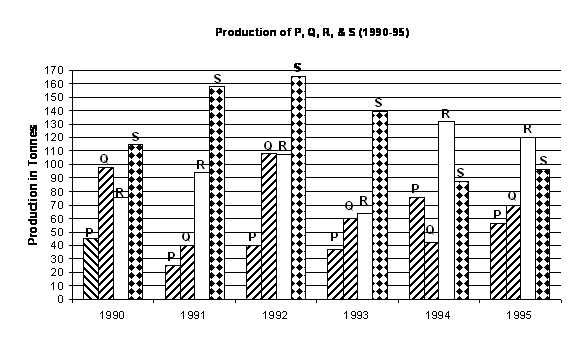
131. In
which year the annual growth rate of total production (of all products) is
highest?
(A) 1991 (B) 1992 (C) 1993 (D) 1995
Solution:
In the year 1992 the annual growth rate is highest it is  .
.
In other years in the choices
the annual growth rate was lesser or else
the total production decreased over the previous year Choice (B)
132. If
the stability of production during 1990 to 1995 is defined as, 
then
which product is most stable?
(A) Product P (B) Product Q (C) Product R (D) Product S
Solution:
Stability = 
The stability is maximum
for S. Its stability is 1.63 Choice
(D)
133. If four products P, Q, R and S
shown in the graph are sold at price of Rs.9, Rs.4, Rs.13 and Rs.3 respectively
during 1990-1995, then the total revenue of all the products is lowest in which
year?
(A) 1991 (B) 1992 (C) 1993 (D) None of the above
Solution:
The productions of Q
and R are minimum in 1993 over the given period. The productions of P and R are
not the maximum over the given period. \ It is possible that
the total revenue of all the products is lowest in 1993. Working out the total
revenue of P and R in each year, it is observed to be minimum in 1993. Total
revenue was the lowest in 1993. Choice
(C)
134. Individual revenue of P, Q, R and S
for the entire period (1990 – 1995) is calculated based on the price of Rs.9,
Rs.4, Rs.13 and Rs.3 respectively. Which product fetches the lowest revenue?
(A) Product P (B) Product Q (C) Product R (D) Product S
Solution:
During the given period
for the production of Q fetches the lowest revenue Choice
(B)
135. Four products P, Q, R and S shown
in the graph are sold at price of Rs.9, Rs.4, Rs.13 and Rs.3 respectively,
during 1990-1995. Which of the following statements is TRUE?
(A) Product R fetches second highest revenue
across products in 1991.
(B) Sum of revenue of P, Q and S is more than the
revenue of R in 1994.
(C) Cumulative revenue of P and Q is more than the
revenue of S in 1993.
(D) None of the above
Solution:
Choice A
It is clear in the year 1991 that
revenue from R = 92  13 = Rs 1556,
revenue from P = 25 9 = Rs 225,
revenue from Q = 42 4 = Rs 168 and
revenue from S = 158 3 = Rs 574
\ Choice A statement is
false.
In 1994,
Sum of revenue from P, Q and S = =675+160+264 = Rs 1099
Revenue of R = 13213 = Rs.1716
Choice B also proves to be false
Choice C
Cumulative revenue from P and Q =
(45+25+40+38)9+ (98+42+108+60)4
=(148 9) + (302 4) = 1332+1208 = Rs
2540
Revenue from S = (115+158+165+140)3 = Rs 1734
Choice C is true Choice (C)